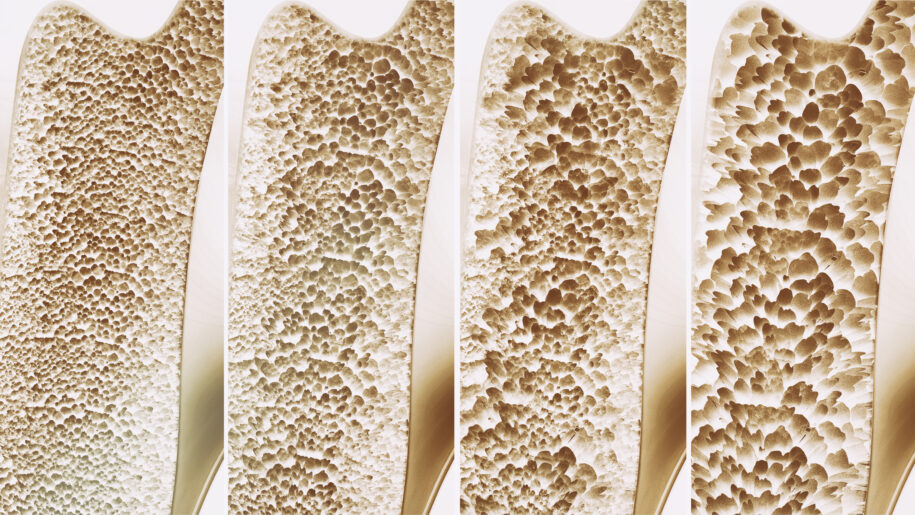
As we age, we tend to lose bone density—this means less and less healthy and strong bones. This does not need to happen. Sadly, with bones, it is hard to know that something is wrong until we get the recommended bone mineral density scans (women age 65 or later, men no official guidelines but some doctors recommend starting at age 70). Another reason for bone density scans (again, which scan for bone minerals—they measure calcium and other minerals within the bones) are having recent fractures, a history of fractures, or being at high risk for bone mineral loss (see below).
Bone density changes slowly; changes can take a year or more to show up on a scan. If density has decreased a lot, the reasons for that have been in place for years. When a scan is done, it shows the effects of habits with nutrition and lifestyle factors from the past.
First, let’s understand how our bones work.
Our bones are solid and hard—the only organ that is solid and hard. But that does not mean that once we are fully grown our bones are done changing. They are not.
Bone mass tends to increase as our bodies grow, typically until our early 20’s. After that, the human body starts a maintenance stage that can last 20-30 years. After that, bone starts to deteriorate. Not because it has anything to do with age—it has more to due with too many risk factors throughout the maintenance phase and beyond (see below).
Bones remodel throughout each stage of life: growth, maintenance, and even when we lose 1 percent of bone mass after age 40 or so. This is accomplished by two main cells:
- osteoclasts that break bones down
- osteoblasts that rebuild bones
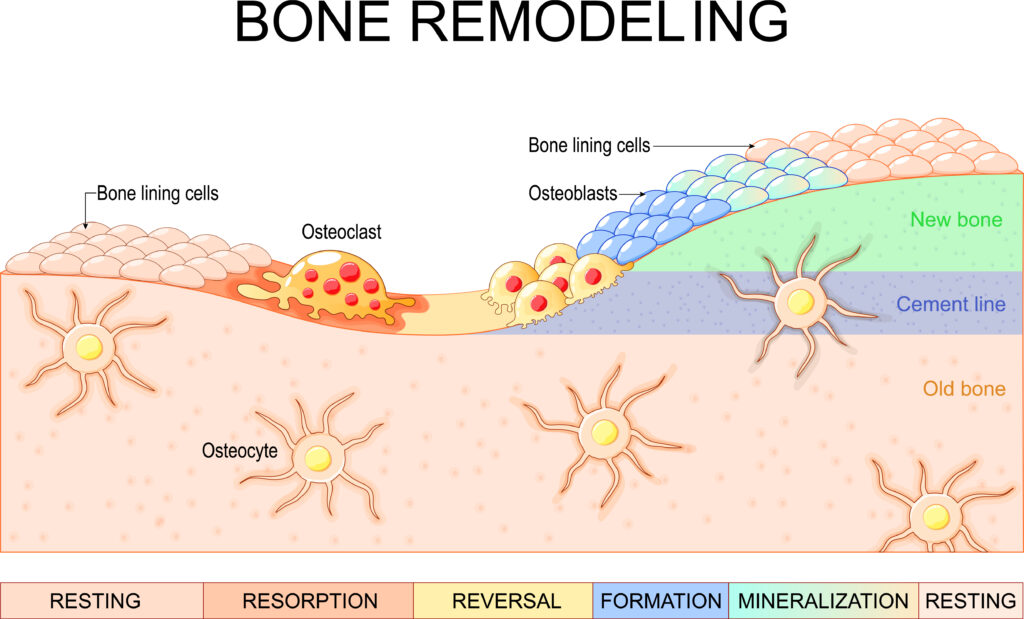
Healthy and strong bones remain so by keeping a balance of breakdown of old bone by osteoclasts and rebuilding new bone by osteoblasts. This continual breakdown/rebuild activity is called “remodeling”. It is actually an important part of bone health. Beyond fractures, bones naturally develop very small cracks that do not mean they are broken and less severe damage from the stresses in our lives—just like any organ can be affected by various life stresses. Remodeling allows the bones to repair these minor damages. Remodeling also prevents the accumulation of “old” bone that is more brittle and likely to crack. In this way, our skeletons completely replace old bone with new bone—that takes about ten years.
To maintain bone health, the bone-building action of osteoblasts needs to balance the destructive action of osteoclasts.
Bones also act as a reservoir of calcium; vital for maintaining regular heart rhythms, nerve functions, blood clotting, muscle contractions, and more… When there is a calcium deficiency, osteoclasts will demineralize the bones. When more bioabsorbable calcium—meaning capable of being absorbed into living tissue (usually dietary calcium or calcium citrate although other forms are emerging)—becomes available, the bone reservoir is replenished. Calcium from oyster shells or limestone is not very bioavailable.
That’s why calcium has traditionally been the single recommended nutrient when a scan shows osteopenia or osteoporosis.
Bone risk factors
Factors you can’t change include:
- Recent fractures or history of fractures
- Female gender
- Declining estrogen levels during perimenopause and after menopause
- Slender, thin-boned man or woman
- Man aged 70 or older
- Prolonged immobility, especially bedridden—PT or OT sessions may shorten the duration
- While there may be multiple genes that increase or protect from bone loss and osteoporosis, these have yet to be verified. There is no single gene responsible. “Inheritance” is more likely to be learned familial habits.
Factors you can change include:
- Ovary removal during childbearing age (ovaries produce estrogen)
- Dietary habits with insufficient calcium, vitamin D, vitamin K2, magnesium (especially during childhood)
- Excessive dieting / eating disorders
- Physically inactive
- Smoking
- Heavy drinking
- Rheumatoid arthritis
- Digestive imbalances, especially use of antacids
- Some types of cancer
- Imbalanced hormones, especially a hyperactive thyroid or too high a dose of thyroid medications
- Gastrointestinal surgeries to reduce stomach size or small intestine length
- All sources of inflammation (chemical and metal accumulations, bacterial/viral/yeast imbalances, parasitic infections, food sensitivities) Talk to me. I use Nutrition Response Testing to find and fix these, often along with an elimination diet to determine the main food category that is causing trouble. Importantly, these can often be seen with a functional medicine review of basic labs rather than is a person “in/out” of range.
Medications* that increase bone loss include:
- Steroids / corticosteroids—usually for autoimmune situations (e.g. rheumatoid arthritis), irritable bowel (IBD), asthma, excsema
- Any antacids (these block stomach acid and prevent mineral release/absorption—Nexium, Prilosec, Prevacid…)
- Psychotropic drugs (SSRIs like Prozac, Zoloft, Paxil; Tricyclic antidepressants
- Hypnotics, depressants usually taken to promote sleep (Ambien, benzodiazepines like Valium, Xanax etc., barbiturates)
- Antiseizure medications like Clonazepam, Gabapentin, etc.
- Cancer drugs that use hormones to treat prostate or breast cancers
*Regarding medications, anything you can do to restore balance and reduce symptoms will also reduce the need for medications, thus decrease risk. If you are taking any medication for any reason, there are still opportunities to improve balance and health by reducing the sources of inflammation—wherever that is coming from.
What’s the best way to monitor bone health?
Remember, unlike blood sugar imbalances or signs of infection, there really are no sensations regarding the gradual bone loss that can start even in your early 40’s. Not until there are fractures, sometimes unexplained, are there clues that bone demineralization has become quite detrimental.
The bone density scan (also known as the DEXA scan) is considered the gold standard to measure the degree of bone mineral loss or lack thereof. These scans show different degrees of bone density: Normal, somewhat low (osteopenia), or very low (osteoporosis). These scans are useful if you use them to measure the long-term changes in actual density resulting from improved diet and lifestyle habits. Unfortunately, bone density changes very slowly. Out of pocket costs can vary from $160 to $1300 depending on Medicare and/or insurance. Medicare normally allows for a scan every two years (recommended at or after age 65 for women or based on multiple fractures for either gender).
In between, the NTx test can show what is happening; whether the bones are demineralizing or rebuilding. This test is useful when used to monitor the effect of any diet and lifestyle changes. More specifically, the NTx test indicates whether there is a good balance between bone rebuilding and bone destruction. Costing somewhere under $100 depending on the lab, the Ntx test is worth using if you make changes as it can show the effects of those changes in as little as a month. Therefore, this test is a quick way to see whether what you are doing is working or if you need to make additional diet, supplement, and/or lifestyle changes.
The Ntx test works like this: As bone is being remodeled, a unique type of collagen is released (recall, collagen is a major component of bones). This type of collagen can be measured in urine making the test completely non-invasive. High levels of this collagen means that bone is being lost; low levels mean that bone density is increasing or at least maintaining.
You may be able to get your doctor to request this test. Before you ask, see if there is a difference with insurance/Medicare coverage if he/she does. Otherwise, the Walk-in Lab currently charges $78 for Quest and $99 for Labcore. See https://www.walkinlab.com/products/view/n-telopeptide-cross-links-ntx-urine-test
I have no affiliation with this lab. Importantly, if you are using the NTx test to monitor the results of changes you are making, you MUST use the same test (lab) each time.
Nutrients and lifestyle changes vital for bone (and other organ) health
Start by reviewing the risk factors, above. Which ones can you change?
Specific nutrients you can get from food and/or supplements:
 Bone broth on its own or as a base for soups. Important note: Skip the Instapot; the longer the bones are simmered, the more collagen and minerals are pulled out of the bones. More minerals and collagen are simmered out by creating a slightly acidic simmer: Add a small amount of apple cider vinegar and some older vegetables that you will discard when done. See Mom’s Healing Bone Broth at OurNutritionKitchen.com
Calcium, Magnesium, and Silicon are plentiful and the right form in plant foods and supplements. Regarding supplements, definitely work with me or another professional to select the bioavailable forms. These are important nutrients for bone formation, especially for mineralization.
Vitamins B2, B6, folate, and B12 are required for normal bone metabolism: B vitamins are normally cleared from the body within 24 hours. Therefore, a diet or supplement that provides a steady supply is vital. They function to break down homocysteine. If homocysteine is high there likely is a B vitamin deficiency. High homocysteine increases risk for osteoporosis among other medical problems (stroke, dementia, cardiovascular disease).
Boron is a mineral that prevents calcium and other mineral loss. Boron is plentiful in Raisins, peaches, prunes, grape juice, apple juice, and noncitrus fruits; green leafy vegetables like kale and chard; potatoes; beans, and green peas; grass-fed/pastured/wild meats, poultry, eggs, seafood; nuts and seeds; avocados. Most of these also have the minerals above and go well in bone broth (there, now I’ve planned a few meals for you 😉)
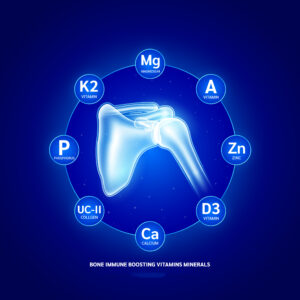 Trace Minerals such as zinc, copper and selenium work together and are also necessary. Once again, nuts (especially Brazil nuts for selenium), other seeds (especially raw pumpkin seeds), leafy green vegetables, pastured eggs, shellfish (what those harvested from polluted waters). Zinc especially takes part in the growth and maintenance of healthy bones.
Eat more protein. Among 1,570 older adults, researchers associated higher bone mass density with higher intakes of total and animal protein. When the protein was sourced from plants, that was associated with lower bone density.
Omega-3 fatty acids (ω-3FAs) such as Docosahexaenoic acid (DHA) and Eicosapentanoic acid (EPA). These healthy fats improve bone quality by preventing bone decay and promoting bone mineralization. They also help move calcium and other minerals out of the blood stream and into places where they belong, like bones.
Specific nutrients you most likely need to supplement:
Vitamins D3 and K2. These work together to ensure that calcium and magnesium make it to the bones. Especially calcium because without D3 and K2 calcium is more likely to contribute to arterial plaque formation and other blood vessel calcification. And… when these nutrients were combined with a quality whey protein (unflavored, nondenatured, just whey; Note: the Standard Process whey protein also includes lecithin sourced from organic soy, a great source of the phosphate bones need although in this case very small amounts and chircory, a fiber that helps with gut health—think healthy bacteria and nutrient absorption)
In truth, you can’t outrun a poor diet with supplements—let’s see what can be done to replace inflammatory foods with some of the above. Inflammation will also cause declining bone density.
Lifestyle:
Weight bearing activites / exercise: This can include just your body weight walking if you are not up to adding weights. When you are ready, add just very light weights that you can hold in your hands (5-10 pounds each) or put in a backpack comfortably.
Caution
A note on Fosamax and other bisphosphonates. Their use has become controversial as they appear to slow down osteoclast breakdown yet there is evidence that they slow down osteoblast rebuilding more—this is an imbalance you don’t want. There are other options including monoclonal antibodies (Denosumab) and recombinant parathyroid hormone (Forteo) to .promote bone rebuilding.
References
Ceylan, M.N., Akdas, S. & Yazihan, N. (2021) Is Zinc an Important Trace Element on Bone-Related Diseases and Complications? A Meta-analysis and Systematic Review from Serum Level, Dietary Intake, and Supplementation Aspects. Biological Trace Elements Research 199, 535–549
Clark, G. R., & Duncan, E. L. (2015). The genetics of osteoporosis. British medical bulletin, 113(1), 73–81.
Fratoni, V., Brandi, M.L.. B Vitamins, Homocysteine and Bone Health. Nutrients; 7(4):2176-2192.
Groenendijk, I., Grootswagers, P., Santoro, A., Franceschi, C., Bazzocchi, A., Meunier, N., Caille, A., Malpuech-Brugere, C., Bialecka-Debek, A., Pietruszka, B., Fairweather-Tait, S., Jennings, A., & de Groot, L. C. P. G. M. (2023). Protein intake and bone mineral density: Cross-sectional relationship and longitudinal effects in older adults. Journal of cachexia, sarcopenia and muscle, 14(1), 116–125.
Hsu, D. J., Lee, C. W., Tsai, W. C., & Chien, Y. C. (2017). Essential and toxic metals in animal bone broths. Food & nutrition research, 61(1), 1347478. (Note: this medical journal article shows that the amount of toxic metals are nearly undetectable; don’t let the title cause concern).
Jensen, P. R., Andersen, T. L., Chavassieux, P., Roux, J. P., & Delaisse, J. M. (2021). Bisphosphonates impair the onset of bone formation at remodeling sites. Bone, 145, 115850.
Kelsey J. L. (1989). Risk factors for osteoporosis and associated fractures. Public health reports (Washington, D.C. : 1974), 104 Suppl(Suppl), 14–20.
Rondanelli, M., Faliva, M. A., Barrile, G. C., Cavioni, A., Mansueto, F., Mazzola, G., Oberto, L., Patelli, Z., Pirola, M., Tartara, A., Riva, A., Petrangolini, G., & Peroni, G. (2021). Nutrition, Physical Activity, and Dietary Supplementation to Prevent Bone Mineral Density Loss: A Food Pyramid. Nutrients, 14(1), 74.
Sharma, T., & Mandal, C. C. (2020). Omega-3 fatty acids in pathological calcification and bone health. Journal of food biochemistry, 44(8), e13333.
Leave a Reply
You must be logged in to post a comment.